Next Generation Biological Identification System for Bio-Threat Detection
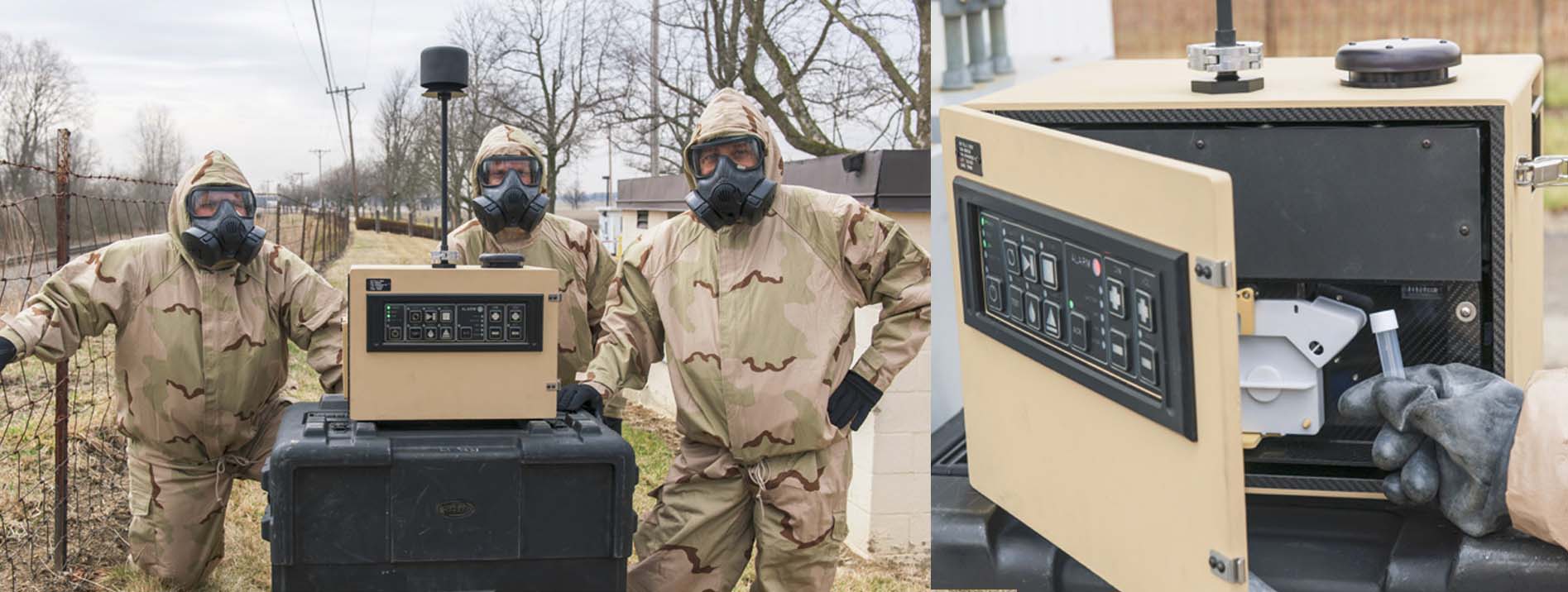
Battelle’s REBS (Resource Effective Bioidentification System) is a fully automated, battery powered biosensor that continuously samples ambient air and identifies a broad range of pathogens. Combining patented aerosol collection with Raman (laser) spectroscopy, REBS provides each captured particle with a unique “biological fingerprint,” so it can recognize hundreds of bacteria, viruses, toxins or even mixed threats without any labels or reagents. The result is near real time detection: field tests report REBS alarming on hazardous agents in minutes, with an average time to alarm of about 22 min for mixed targets. Unlike legacy systems, REBS requires no refrigerated reagents (no cold chain), so it can run 24/7 at very low cost. Independent trials including live agent tests in transit systems – have demonstrated near zero false positives and highly sensitive detection, making REBS a powerful tool for homeland security, public health and defense.
The Biothreat Detection Challenge
Detecting airborne pathogens is notoriously hard. Conventional bioaerosol detectors typically target only a handful of organisms and often use expensive, perishable chemistries. These older systems suffer from limited libraries, high false alarm rates and heavy logistics (daily reagent replenishment and cold storage). As a result, continuous monitoring (for example across an airport, hospital or city network) has been prohibitively costly and unreliable. Emerging threats – from engineered bioweapons to novel pandemics – only worsen the challenge. Modern biosurveillance needs a rugged sensor that can scale up to hundreds of targets, operate autonomously for days or weeks, and rapidly alert first responders or analysts with high confidence.
The REBS Solution
REBS was specifically designed to overcome these gaps. It continuously pulls ambient air, capturing aerosolized particles into a sampling cell, then illuminates them with a laser. The Raman scattered light yields a molecular “spectral signature” for each particle. By comparing these spectra to its onboard library, REBS can identify hundreds of pathogens – well beyond what older detectors could handle. Because the analysis is optical and nondestructive, REBS preserves each sample for archiving or follow up tests. The entire cycle (sample in to ID out) takes only minutes: REBS can sample air on the order of every 30 seconds and report a presumptive ID to the network within 2–3 minutes.
REBS achieves high sensitivity with near zero false alarms. In government evaluations using live agents and realistic simulants, REBS consistently detected biothreats at low concentrations (on the order of 5–190 particles per liter, depending on the target). For example, U.S. trials found average identification probabilities of ~150 particles/L for bacteria, 130 particles/L for toxins and 190 particles/L for viruses, with no spurious alerts under test conditions. This dramatic performance leap is due to the combination of continuous sampling and advanced spectroscopy – every second, the system is gathering fresh data and ruling out false positives.
Key Features & Benefits
Broad Spectrum Identification
REBS identifies hundreds of biological agents including bacteria, viruses, toxins, and mixed threats using an extensive, updateable signature library. New threats can be added remotely within 24 hours, ensuring rapid adaptation to emerging pathogens.
Fast Detection & Real Time Alerts
The system samples air every 30 seconds and provides presumptive threat identification within minutes. Field evaluations have shown average time to alarm of ~22 minutes, enabling rapid response during critical incidents.
Near Zero False Alarms
REBS uses optical spectroscopy instead of biochemical assays, resulting in exceptional accuracy and virtually no false positives, even during extended trials in high traffic, complex environments such as public transit systems.
Rugged, Portable & Network Ready
Compact (approx. 18×12×12 in, 35 lbs) and battery powered for up to 30 days, REBS is designed for field deployment. It stores all spectral and physical samples automatically and integrates easily with existing biosurveillance networks via Ethernet or secure wireless communication.
Proven in Real World Deployments
REBS has been successfully used in government trials, defence programs, hospitals, and transit systems, demonstrating reliability in operational environments. Upgraded versions support liquid sample analysis, faster response times, and mobile platform integration.
Technical Highlights
- Dimensions: ~18×12×12 in; Weight: ~35 lbs
- Power: AC or BA-2590 battery (up to 30 days runtime)
- Operating Temp: 0–50°C, up to 100% RH
- Communications: Ethernet or 900 MHz secure wireless
- Optional: Liquid sample analysis port